TL;DR
- Pluad AI aims to turn meeting conversations into summaries and follow-ups.
- It’s useful if you want quick recaps, but you should check accuracy on names, numbers, and commitments.
- The main decision is workflow fit: capture → transcript → summary → share.
- If you need consistent action items, templates, and reliable output, prioritize tools that support structured summaries.
- Test it with 2-3 real meetings before committing.
—
If you search for “AI meeting notes” tools, you’ll run into a lot of similar promises: summaries, action items, and “never miss a detail again.” Pluad AI is in that category.
This review focuses on practical questions:
- What is Pluad AI good at?
- Where does it fall short?
- Who is it actually for?
- How do you evaluate it quickly with real meetings?
What is Pluad AI?
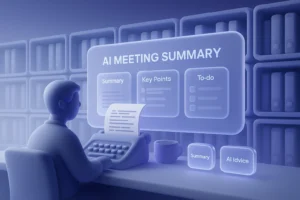
Pluad AI is a meeting assistant-style tool designed to help you capture meeting content and turn it into usable output like:
- meeting summaries
- action items
- key takeaways
- follow-up drafts
The value proposition is simple: spend less time writing notes and more time executing.
How Pluad AI typically fits into a workflow
Most people end up using a pattern like this:
1) Join or record a meeting
2) Create a transcript
3) Generate a summary
4) Share notes with the team
5) Track action items elsewhere (task tool, doc, or project board)
If your team already has a consistent meeting notes format, you’ll want to check whether Pluad AI can output in that structure.
What Pluad AI does well
1) Quick summaries for internal syncs
For weekly team syncs or routine updates, fast summaries can be enough. If the meeting is low-stakes and the goal is awareness, a short recap saves time.
2) Capturing action items (when the meeting is explicit)
AI tools perform better when people clearly assign ownership:
- “Alex will send the proposal by Friday.”
- “Jin will update the doc today.”
If your meetings already sound like that, you’ll get better action item output.
3) Reducing the blank-page problem
Even if you don’t trust an AI summary 100%, it gives you a first draft. Editing a draft is faster than writing from scratch.
Where Pluad AI can disappoint
1) Accuracy on names, numbers, and commitments
This is the biggest risk across all meeting AI tools.
You should always validate:
- personal names
- pricing or KPI numbers
- deadlines
- “we agreed to X” statements
A wrong action item is worse than no action item.
2) “Generic” summaries that feel interchangeable
If the output reads like:
- “The team discussed progress and next steps.”
Then it’s not doing the job. Your notes should be specific enough to execute.
3) Misalignment with your preferred note format
Most teams want notes in a structured template:
- outcomes
- decisions
- action items (owner + due date)
- open questions
If a tool can’t reliably produce that format, you end up rewriting anyway. Tools that support structured summaries (for example an AI note taker) tend to reduce the cleanup work.
Who should use Pluad AI (and who shouldn’t)
Good fit if you are:
- A manager who needs fast context across many meetings
- A team that wants lightweight recaps instead of perfect documentation
- Someone who wants a “first draft” and is willing to edit
Not a great fit if you need:
- compliance-grade transcripts
- high-stakes accuracy (contracts, legal, medical, finance)
- consistent structured notes without editing
- guaranteed follow-up automation end-to-end
How to test Pluad AI in 30 minutes
Here’s a fast evaluation method that avoids “demo bias.”
Step 1: Use a real meeting (not a sample)
Pick a meeting with:
- at least 3 people
- clear decisions
- at least 2 action items
Step 2: Score the output
Use a quick checklist:
- Summary captures the right outcomes (yes/no)
- Decisions are correct (yes/no)
- Action items include owners (yes/no)
- Action items include dates (yes/no)
- Names are correct (yes/no)
- Numbers are correct (yes/no)
Step 3: Measure edit time
If you still spend 10-15 minutes cleaning up every meeting, you’re not saving time.
Step 4: Check sharing and consistency
Ask: can my team scan this in 20 seconds and know what to do?
Alternatives: what to compare when choosing an AI notes tool
Instead of comparing marketing pages, compare these capabilities:
- transcript quality and speaker separation
- structured summary templates
- action items extraction quality
- export options (Docs, Notion, Markdown)
- privacy controls and permissions
If you’re building a repeatable process for meeting follow-ups, prioritizing structure usually matters more than “fancy” summaries. A good baseline is a work meeting workflow that consistently turns conversations into decisions and action items.
FAQ
Is Pluad AI worth it?
It can be worth it if it fits your workflow and you’re using it to draft recaps. It’s less worth it if you need high accuracy without any editing.
Does Pluad AI generate action items automatically?
Most tools attempt action items extraction. In practice, it works best when the meeting includes explicit ownership and deadlines.
How do I evaluate AI meeting notes tools?
Test with real meetings, score decisions and action items for accuracy, and measure how long you spend editing the output.
What should I watch out for with AI summaries?
Incorrect names, numbers, and commitments. Always review high-impact details.
—
If your goal is consistent meeting follow-ups, look for a workflow that turns a transcript into structured outcomes, decisions, and action items. You can start here: https://proactor.ai/app/login