
I. Why Key Takeaways Matter
Every great meeting ends with clarity — and that clarity lives inside your key takeaways.
Unlike generic meeting notes or long-winded meeting summaries, key takeaways are precise, result-driven statements that highlight decisions made, actions assigned, and what needs to happen next. They provide alignment, accountability, and direction.
For example:
Instead of writing “We discussed product launch,”
write “Finalize product launch timeline by next Tuesday.”
Key takeaways act as the blueprint for follow-up actions. And today, smart tools like Proactor AI make this effortless — by capturing and summarizing your meetings in real time as you speak, not after the fact.
II. What Are Key Takeaways in a Meeting?

Key takeaways summarize what truly matters — the final decisions, priorities, and actions that define a meeting’s success.
To understand them clearly, let’s break them into three layers:
- Summary – A high-level recap of the meeting’s purpose and scope.
- Discussion Points – The main ideas, debates, and perspectives exchanged.
- Key Takeaways – The distilled outcomes: what was decided, who owns what, and when it’s due.
Examples of strong takeaways:
- ✅ “Approve new pricing model for Q1.”
- ✅ “Assign design update to UI team.”
- ✅ “Schedule customer beta test by Oct 20.”
These are short, actionable, and immediately useful for decision tracking and execution.
III. The Role of Key Takeaways in Modern Meetings
In today’s fast-paced, hybrid-first workplaces, meetings happen constantly — and it’s easy for critical information to get lost.
That’s where key takeaways come in. They bridge the gap between discussion and execution, transforming a 30-minute conversation into focused next steps.
Thanks to digital collaboration tools like Zoom, Google Meet, and Proactor, your takeaways can now be:
- 📤 Shared across teams
- 🔍 Easily searched later
- 🔗 Linked with tasks, owners, and deadlines
Imagine this: a half-hour product sync yields 4–6 actionable items, each feeding directly into your project roadmap. That’s the power of clear takeaways.
Tools like Proactor AI automatically capture, refine, and structure key takeaways — turning your voice into organized meeting insights.
IV. How to Write Effective Key Takeaways (Step-by-Step)
Writing great key takeaways isn’t about writing more — it’s about writing what drives action.
Here’s a proven 5-step framework:
- Focus on outcomes, not conversations
- Write what was decided, not what was said.
- ✅ “Confirm Q2 sales forecast” > ❌ “Talked about sales performance.”
- Use active, concise language
- Begin with verbs like: Approve, Assign, Launch, Schedule.
- Add ownership and deadlines
- Include who’s responsible and by when.
- ✅ “Assign landing page update to Sarah by Oct 18.”
- Be specific and measurable
- Avoid vague goals.
- ❌ “Improve UX” → ✅ “Reduce checkout time by 20%.”
- Group logically
- Use categories: Decisions / Actions / Insights / Follow-ups.
💡 Pro Tip: Follow the formula
“Action + Owner + Deadline” — the same one used by Proactor AI’s Key Takeaways Engine.
V. Examples of Well-Written Key Takeaways
Let’s compare poor vs effective examples:
| Poor Example | Improved Example |
|---|---|
| “We discussed marketing ideas.” | “Finalize Q1 campaign themes by Friday.” |
| “Team talked about bugs.” | “Fix top 3 bugs before next sprint.” |
| “Improve communication.” | “Schedule weekly sync between sales & dev.” |
Why these work:
- Clear intent
- Defined owner and deadline
- Measurable outcome
Writing better meeting notes starts with better key takeaways.
VI. Common Mistakes When Writing Key Takeaways
Even seasoned note-takers fall into these traps:
- ❌ Too vague or descriptive – “We reviewed analytics” says nothing.
- ❌ Missing owners/deadlines – No accountability = no action.
- ❌ Mixing discussions with decisions – Separate “what we explored” from “what we agreed.”
- ❌ Redundancy – Repeating the same point in 3 ways.
🧠 Proactor AI prevents these by:
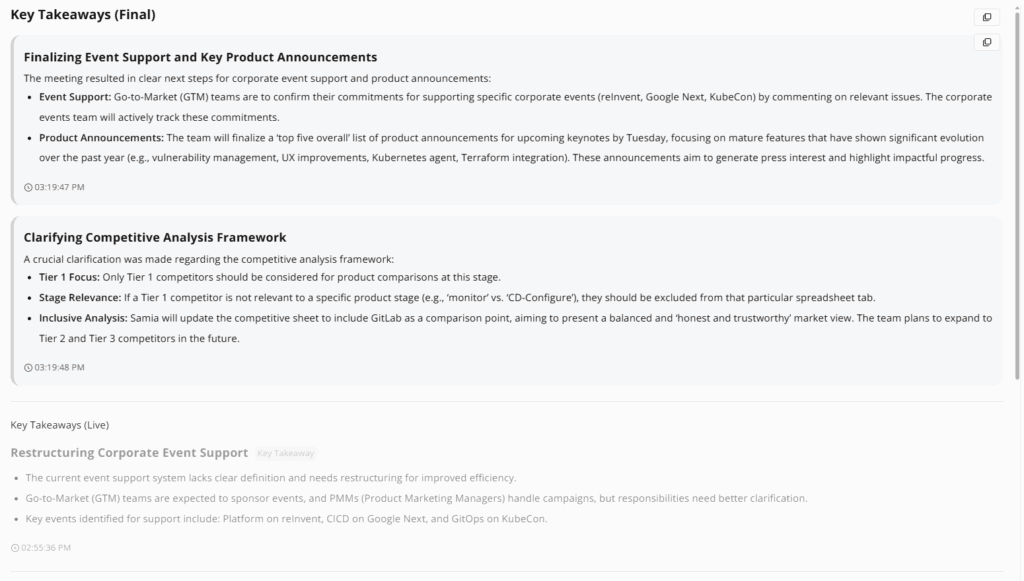
- Attaching timestamps to each takeaway
- Auto-tagging actions, insights, and owners
- Cleaning up duplicates and noise post-meeting
Before finalizing, read each takeaway as if you weren’t in the room. Does it still make sense? If yes, you’ve nailed it.
VII. How AI Tools Like Proactor Simplify Key Takeaways
AI meeting assistants like Proactor are changing the game. Here’s how:
| Aspect | Manual Writing | With Proactor |
|---|---|---|
| Speed | After meeting | Instant, real-time |
| Accuracy | Subjective | Based on full transcript |
| Context | Often missing | Linked with entire dialogue |
| Actionability | Needs rewriting | Auto-generates To-do & AI Advice |
Proactor AI offers:
- Live Takeaways: Real-time snippets generated during the meeting
- Final Takeaways: Post-meeting synthesis that merges & refines results
- Semantic memory: Cross-meeting insights from past discussions
- To-do linking: Each takeaway can trigger a task, follow-up, or in-depth advice
You speak. Proactor listens, thinks, and acts — instantly.
VIII. Template: Key Takeaways Format You Can Reuse
Here’s a battle-tested template — or just let Proactor generate this for you.
Meeting: Product Launch Sync – Oct 13, 2025

1. Decision — Approve final feature list by Friday.
2. Action — Assign UX redesign to Alice, due Oct 20.
3. Insight — Customer feedback favors simpler onboarding.
4. Follow-up — Schedule post-launch review next Tuesday.
You can export this from Proactor as PDF or Markdown, with clickable links to related audio.
IX. Conclusion + Call to Action
Clear key takeaways make meetings worth the time. They’re how ideas turn into momentum.
Instead of drowning in meeting summaries and half-written notes, modern teams use AI-powered tools to stay sharp, aligned, and fast-moving.
With Proactor AI, you don’t just write better notes —
You capture insight, assign action, and move forward in real time.
Ready to transform your meetings?
👉 Try Proactor AI now — your proactive teammate for smarter meetings, better notes, and actionable outcomes.