
An objective summary is more than just a condensed version of a longer text. It’s a deliberate, structured process that requires extracting the essence of an original message—main idea, key supports, and conclusion—without introducing bias, interpretation, or emotion. This article offers a comprehensive guide to mastering the art of objective summaries. You’ll learn:
- The exact difference between objective summary and paraphrasing
- How to follow a 7-step method aligned with a professional 4-stage writing workflow
- How to avoid common mistakes like injecting opinion, over-simplifying, or omitting vital context
- The ethical use of language and tone in an objective summary
- Examples from real-world contexts: academic papers, meetings, and articles
- Tools like rubrics, templates, and AI assistants (e.g., Proactor) that can elevate your summary writing
Whether you’re a student, business professional, educator, or product manager, this article will teach you how to write objective summaries that are accurate, concise, and neutral—while developing your reading comprehension and critical thinking at the same time.

What Is an Objective Summary?
An objective summary is not meant to persuade or critique, but rather to convey the original author’s message faithfully and briefly. It does not include personal interpretations, emotional tone, or opinions. Instead, it identifies the source’s main idea and key support points, and then restates them in your own words.
✳️ Tip
Writing a good objective summary requires you to distill what matters most, without reshaping the message or tone. It is not a retelling, but a reconstruction.
A strong objective summary:
- Focus on who said what and how they supported it
- Avoids judgmental words such as “great,” “flawed,” or “obvious”
- Can stand alone, even if the reader hasn’t seen the original
Why and When to Use It
You may need to write objective summaries in various contexts—whether in school, work, or your daily digital life. For example:
- In academics, to capture key ideas from articles or lectures
- In business, to document meetings or proposals
- In resumes or interviews, to describe experience neutrally
- In legal or policy writing, to summarize statutes or opinions
No matter the context, the value of an objective summary lies in its clarity. It saves time, improves decision-making, and preserves the integrity of the source.
Objective Summary as Metacognitive Skill
An objective summary is not just a writing task, but also a thinking process. You must understand the original content, then select what’s essential, and finally restate it clearly. This process strengthens comprehension, self-awareness, and your ability to think critically. In essence, summarizing trains your brain to balance what to keep and what to let go.
The Three Pillars: Accuracy, Brevity, Objectivity

To write an effective objective summary, you must balance three core traits:
- Accuracy ensures you reflect the source correctly
- Brevity ensures you leave out what’s unnecessary
- Objectivity ensures you communicate without bias
These traits are not separate. If you shorten too much, you may lose accuracy. If you add your opinions, you lose objectivity. Therefore, the key is to weigh these three together in every summary you write.
🎯 Insight
If you simplify too much and lose key context, the summary becomes misleading — and thus, no longer objective.
The Four-Stage Framework for Expert Summarizers
Before diving into the step-by-step method, it’s helpful to look at the bigger picture. The process of summarizing can be seen as four recursive stages:
| Stage | Purpose | Related 7 Steps |
|---|---|---|
| 1. Understand | Deeply read & comprehend source | Step 1 & 2 |
| 2. Filter | Select only core arguments & facts | Step 2 (continued) |
| 3. Write | Rephrase, neutralize, and structure clearly | Step 3–6 |
| 4. Refine | Verify against source & remove bias | Step 7 + Rubric |
Each stage helps prepare for the next. Moreover, you may revisit earlier stages as you refine your work.
7-Step Method to Write an Objective Summary

Step 1: Skim and Identify Thesis
Look for the main point, but don’t stop there. Also note the author’s purpose, tone, and any framing language.
Step 2: Extract Core Information
Write down what’s truly essential: key claims, supporting evidence, conclusions. Avoid copying full sentences.
Step 3: Rewrite in Your Own Words
Don’t just change a few words. Instead, write as if explaining to a colleague what the original said.
Step 4: Eliminate Subjectivity
Replace emotional or exaggerated words with neutral alternatives. This also includes soft biases like “clearly” or “importantly.”
Step 5: Use Neutral Sentence Structures
Instead of saying “the author believes,” try “the author states” or “the report suggests.” These keep your tone factual.
Step 6: Organize Into One Paragraph or 3 Bullets
Whether you write one paragraph or three bullet points, structure matters. Avoid mixing main points and examples.
Step 7: Re-Read & Check Against Source
Read your summary side-by-side with the original. Ask yourself: Did I change the tone or leave anything major out?
How to Use Language Objectively in a Summary
A well-written summary doesn’t just report what was said—it reflects how it was said, using language that remains neutral, respectful, and free of personal opinion. That means being careful not only about what information you choose, but also how you present it.
Words That Introduce Bias (Avoid These)
- good, bad, important, obvious, amazing, flawed, successful, should, clearly, fortunately
These words imply judgment, exaggeration, or opinion. A reader should draw their own conclusions from the facts, not be steered by the writer’s word choices.
More Neutral Alternatives (Use These Instead)
- The article reports that…
- The author concludes based on…
- The policy recommends due to…
- The data shows a 12% increase, not “successfully improved”
🧠
Writing without bias doesn’t make your work bland—it makes it trustworthy.
Two Simple Templates for Clear, Objective Summaries
Sometimes structure is all you need to stay focused. Try one of the following:
One-Paragraph Template
“In the article [Title], the author [verb] that [main idea]. This is supported by [point 1], [point 2], and [point 3], and the author concludes that [final takeaway].”
Three-Bullet Template
- The author claims…
- They support this with…
- They conclude that…
Before & After: A Quick Rewrite
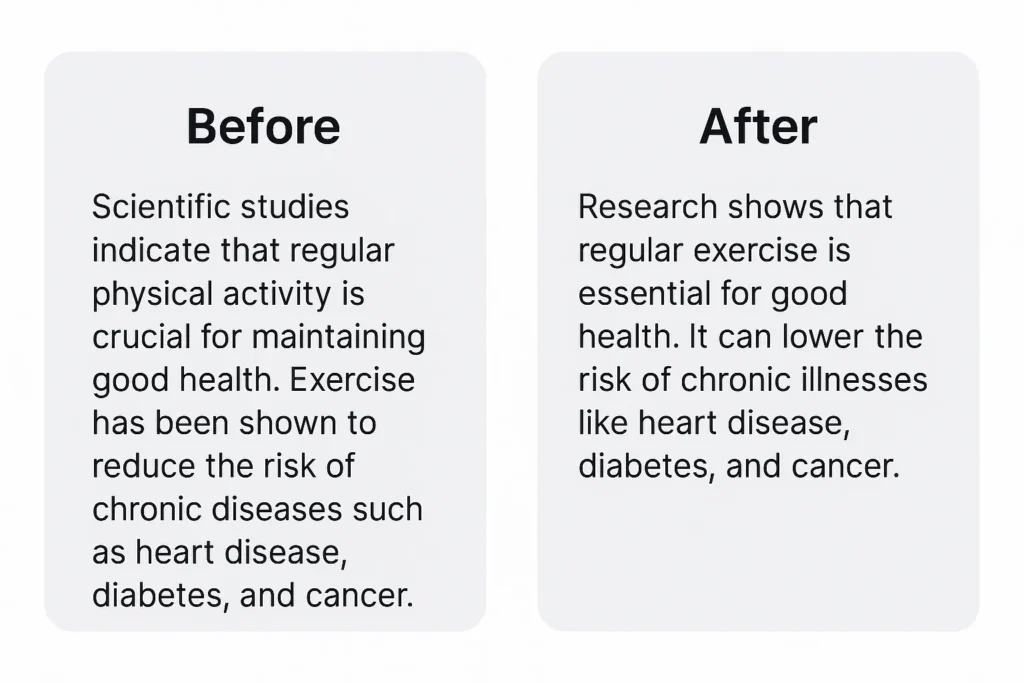
Before
“This article does a great job proving why climate change is super important.”
After
“The article argues that climate change policies are needed based on new data and growing public health concerns.”
The second version avoids praise, adjectives, and vague intensifiers. It sticks to what the article says, not how the reader feels about it.
Real-World Examples from Meetings, Articles, and Research
Article Summary
“The article explains how reducing screen time may improve mental health, work productivity, and real-life connection.”
Meeting Summary
“In this week’s sales meeting, the team discussed declining conversion rates and agreed to test new landing pages and update CRM settings.”
Research Summary
“The study reports a 12% productivity increase among remote software engineers, especially those with prior remote work experience.”
Common Mistakes & How to Fix Them

| Mistake | Fix |
|---|---|
| Injecting opinions | Replace with neutral reporting verbs |
| Copy-pasting quotes | Paraphrase in own words |
| Overloading with details | Limit to 2–3 key points |
| Removing context | Retain who, what, and why |
| Ignoring tone/purpose | Reflect the original’s intent, not your judgment |
| Swapping synonyms only | Reconstruct sentence logic, not just vocabulary |
| Oversimplifying complex ideas | Include relevant qualifiers (time, scope, conditions) |
| Misunderstanding satire/intent | Clarify rhetorical purpose if relevant |
💡 Did You Know?
Most summary mistakes are actually reading mistakes. You can’t summarize what you haven’t fully understood.
Evaluation Checklist
For Everyone
- Accuracy: Does it match the source?
- Coverage: Did you include the main idea and two key points?
- Clarity: Is it easy to follow?biguity
- Brevity: Is anything included that doesn’t need to be?
- Objectivity: Did you avoid opinion or emotion?
👍 A score of 8 or more (out of 10) means you’re on the right track.
For Advanced Writers
- AccIs the summary fact-based and logically sound?
- Does it reflect multiple types of evidence (data, examples, reasoning)?
- Is the language neutral from start to finish?
- Is it written with the reader’s needs in mind?
- Are the ideas smoothly connected?
Objective vs Subjective vs Critical Analysis
| Attribute | Objective Summary | Subjective Summary | Critical Analysis |
|---|---|---|---|
| Purpose | Inform | Reflect or persuade | Evaluate or interpret |
| Tone | Neutral, factual | Personal, emotional | Analytical, persuasive |
| Content | Main idea + 2–3 supports | Add reactions/opinions | Dissect logic/structure |
| Writer role | Information deliverer | Commentator | Analyst/critic |
| Language | “The author reports…” | “I think…” | “This argument is effective because…” |
AI-Assisted Summary: How Proactor Applies These Principles

AI tools like Proactor or others can help you organize your notes and start a draft. They’re helpful for saving time and catching repetition—but they don’t know your intent.
In Proactor:
- 🎯 Live AI Summary: Extracts key points during meetings using objective framing.
- ✏️ Final Summary Suggestions: Highlights weak verbs, redundant info, and bias.
- 🔎 Quality Checks: Applies Rubric scoring engine and highlights subjective language.
- 🧠 User Refines Output: Applies 4-stage process before publishing or sharing.
Best Practices:
- Treat AI output as a first draft, not final
- Always verify facts and tone
- Watch for satire, cultural context, or implied bias
Quick Self-Check Before Publishing
- [ ] Did I use my own words?
- [ ] Did I eliminate all opinions or emotion?
- [ ] Does it include the main claim and top 2–3 supports?
- [ ] Is it understandable without reading the original?
- [ ] Did I fact-check against the source?
- [ ] Does it follow the 4-stage workflow?